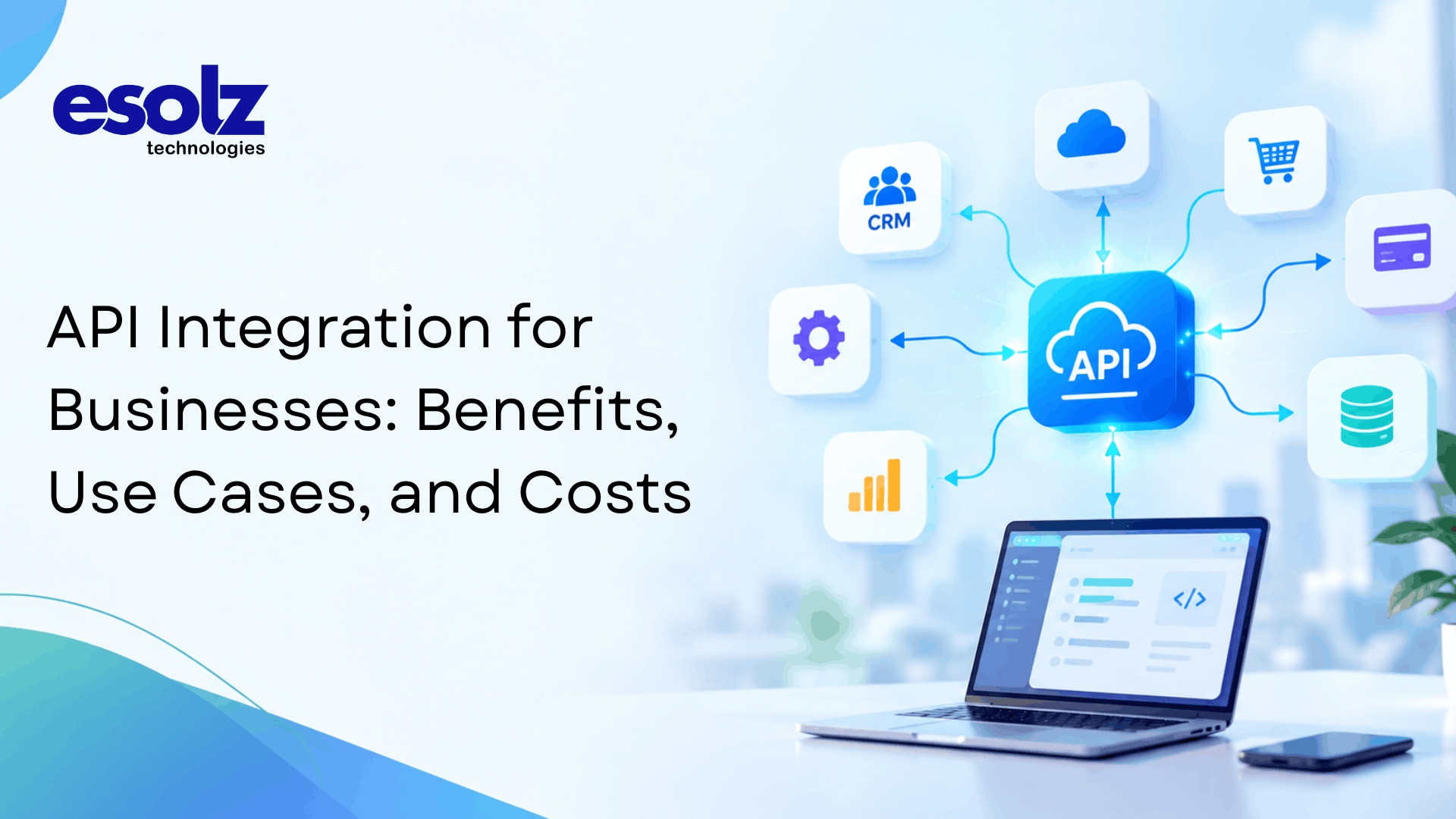
Every business runs on software. You have a website, a CRM, an accounting tool, and maybe a mobile app. The problem starts when these tools do not talk to each other. Teams copy data by hand. Orders get delayed. Customers feel the gap. This is where API integration for businesses makes a real difference. It connects your systems so data flows on its own. In this guide, you will learn the benefits, real use cases, and costs. You will also find timelines, risks, and tips to get it right the first time.
What Is API Integration for Businesses?
API stands for Application Programming Interface. Think of it as a waiter in a restaurant. You tell the waiter what you want. The waiter takes your order to the kitchen. Then the food comes back to your table. An API does the same job between two software systems.
API integration for businesses means connecting your apps, tools, and platforms through APIs. Once connected, they share data in real time. Your online store can tell your inventory system about a new order. Your inventory system can then update stock. No one has to type anything twice.
How Does API Integration Work?
It follows a simple flow. One system sends a request. The other system checks it and sends back a response. This happens in milliseconds. Most modern APIs use REST or GraphQL. They send data in JSON format. It is light, fast, and easy to read.
Types of APIs Businesses Use
- Public APIs: open to any developer. Google Maps is a common example.
- Private APIs: used inside one company to link internal tools.
- Partner APIs: shared with selected business partners.
- Composite APIs: combine several calls into one request.
Why Companies Need API Integration Today
Customers expect speed. They want live order tracking, instant payments, and quick support. Manual work cannot keep up. Disconnected tools also create data silos. One team sees one number. Another team sees a different one. Decisions suffer.
Growth adds more pressure. Each new tool adds more complexity. APIs keep that complexity under control. They let you add, swap, or upgrade software without rebuilding everything.
Signs Your Business Needs API Integration
Not sure if it is time? Check this list. If you nod at two or more, you are ready.
- Your team copies data between tools every day.
- Customers complain about wrong stock or late updates.
- Reports take days because data lives in many places.
- You plan to launch an app, a new store, or a new market.
- Your current software cannot connect to new tools.
These are classic signs of disconnected systems. The sooner you fix them, the less time you lose.
Key Benefits of API Integration for Businesses
The benefits of API integration for businesses are practical. You can see them in daily work within weeks.
Saves Time Through Automation
Manual data entry eats hours. An API removes it. Invoices can be created from orders automatically. Leads can flow from your website into your CRM in seconds. Your team can focus on work that needs human thinking.
Fewer Errors and Better Data Quality
People make typing mistakes. Software does not. When data moves through an API, it stays consistent. You get one source of truth. Reports become more reliable.
Better Customer Experience
Customers notice smooth journeys. Real-time stock updates avoid overselling. Live shipping status reduces support calls. Saved payment methods make checkout faster. Every connected touchpoint builds trust.
Easy Scalability
As you grow, your tools must grow too. APIs let you plug in new services quickly. You can add a new payment gateway in days, not months. You can also enter new markets without rebuilding your stack.
Lower Operating Costs
Automation cuts labour costs. Fewer errors cut rework costs. You also avoid buying all-in-one software that you only half use. With the right APIs, you pick the best tool for each job and connect them.
Real-Time Insights for Faster Decisions
Connected systems feed dashboards live. Sales, stock, and support data sit in one place. Leaders can act on today’s numbers, not last week’s report.
Stronger Security and Control
Well-built APIs use authentication, encryption, and rate limits. Access can be limited by role. You also reduce the risk of data leaks from spreadsheets and email attachments.
Real-World Use Cases Across Industries
Here is how API integration for businesses works in practice across common industries.
eCommerce and Retail
Online stores connect storefronts with payment gateways, shipping carriers, and inventory tools. An order triggers a shipping label, a stock update, and a customer email. All of it happens without manual steps.
Payments and Fintech
Payment APIs such as Razorpay, Stripe, and PayPal handle secure transactions. Banks use APIs for account checks, UPI, and loan processing. Fintech apps rely on them for KYC and fraud checks.
CRM and Marketing
Link your website forms, email tools, and CRM. A new lead enters Salesforce or HubSpot instantly. Marketing can then trigger a follow-up email or WhatsApp message.
ERP and Accounting
Sync sales, purchase, and payroll data with tools like SAP, Zoho Books, or Tally. Finance teams close the books faster. Audits become easier.
Logistics and Supply Chain
Track shipments live with carrier APIs. Route data, delivery status, and proof of delivery flow back into your system. Customers get accurate delivery estimates.
Healthcare
Hospitals link patient records, lab systems, and appointment tools. Secure APIs help meet privacy rules while saving time for staff.
Travel and Hospitality
Booking engines pull rates and availability from airlines, hotels, and channel managers. Prices stay current across every platform.
Mobile and Web Apps
Most apps are built on APIs. Login, maps, chat, notifications, and analytics all come from connected services. Your app team can ship faster by reusing them.
How Much Does API Integration for Businesses Cost?
Cost is the top question clients ask. The honest answer is that it depends. A simple connection can cost very little. A complex enterprise project can cost much more. Here is a clear breakdown.
Typical Cost Ranges
| Project Size | What It Covers | Estimated Cost | Timeline |
| Simple | One third-party API, such as a payment gateway or SMS | INR 25,000 to 1,00,000 (USD 300 to 1,200) | 1 to 3 weeks |
| Medium | 2 to 4 systems, such as CRM and ERP, with custom logic | INR 1,00,000 to 4,00,000 (USD 1,200 to 5,000) | 4 to 8 weeks |
| Complex | Enterprise setup, legacy systems, many connections | INR 4,00,000 to 15,00,000+ (USD 5,000 to 18,000+) | 3 to 6 months |
These are indicative ranges only. Your final quote depends on scope, tools, and compliance needs.
Factors That Affect the Cost
- Number of systems you want to connect.
- Quality of the API and its documentation.
- Custom logic and data mapping.
- Legacy systems with no modern API.
- Security and compliance rules, such as HIPAA or GDPR.
- Real-time sync versus scheduled batch updates.
- Testing depth and number of environments.
Ongoing and Hidden Costs
The build is not the only expense. Plan for these as well.
- Third-party API fees, often charged per call or per month.
- Hosting, monitoring, and logging tools.
- Maintenance when providers change API versions.
- Support, bug fixes, and small updates.
- Documentation and team training.
A good rule of thumb is to set aside 15 to 20 percent of the build cost each year for maintenance.
How to Reduce Integration Costs
Start with the workflow that gives the most value. Choose tools with strong documentation. Reuse existing connectors where they fit. Define scope clearly before work begins. Build in phases. Test early so problems stay small.
How Long Does API Integration Take?
Simple projects take one to three weeks. Mid-size projects take four to eight weeks. Large enterprise projects can take several months. Timelines depend on documentation, approvals, and testing. Most projects follow these steps.
- Discovery and planning: define goals, systems, and data flow.
- API selection and design: pick the right endpoints and formats.
- Development and data mapping: build the connection and map fields.
- Testing: check speed, errors, and edge cases.
- Deployment: go live in stages to reduce risk.
- Monitoring and support: track performance after launch.
Common Challenges and How to Solve Them
- Poor documentation: ask for a sandbox and sample calls before you commit.
- Version changes: track provider announcements and plan updates ahead.
- Security risks: use OAuth 2.0, encryption, and strict access rules.
- Rate limits: add queues and caching to avoid blocked requests.
- Data mismatch: set clear field mapping and validation rules.
- Downtime: build retries and fallback plans into the design.
Best Practices for a Smooth Integration
- Set clear business goals first.
- Test in a sandbox before going live.
- Add error handling and automatic retries.
- Log every request so issues are easy to trace.
- Keep clear documentation for your team.
- Design for growth, not just today’s volume.
No-Code Tools or Custom API Integration?
No-code platforms like Zapier and Make are quick to set up. They suit simple tasks, such as sending form leads to a spreadsheet. They also cost little at the start.
But they have limits. Pricing grows with volume. Complex logic is hard to build. Data control and security can also be a concern.
Custom integration costs more upfront. In return, you get full control, better speed, and deeper logic. It also scales without extra per-task fees. Many companies start with no-code and move to custom work as they grow.
What Is Next for API Integration?
AI is changing the space. Smart assistants now call APIs to book, track, and update on your behalf. Event-driven systems send data the moment something changes. Expect faster, smarter connections in the years ahead. Businesses that build a solid API foundation now will adapt more easily.
How to Choose the Right API Integration Partner
The right partner saves money and stress. Look for these signs.
- Proven experience with similar systems and industries.
- A clear process and open communication.
- A security-first approach.
- Transparent pricing with no surprises.
- Support after launch, not just delivery.
- Case studies and client references.
Why Businesses Choose Esolz Technologies
Esolz Technologies helps companies plan and deliver API integration for businesses of every size. Our team works with eCommerce, healthcare, travel, education, and service brands. We start by understanding your workflow. Then we design an integration that fits it.
- Custom and third-party API integration.
- REST, SOAP, and GraphQL support.
- ERP, CRM, payment, and shipping connections.
- Secure, tested, and well-documented delivery.
- Maintenance and support after launch.
Want to know what your project may cost? Talk to our team for a free consultation.
Frequently Asked Questions
What is API integration in simple words?
It is a way to connect two software tools so they share data automatically. You do not need to copy and paste anything.
What are the main benefits of API integration?
You save time, reduce errors, and improve customer experience. You also scale faster and get real-time data for better decisions.
How much does API integration cost?
Simple projects may start around INR 25,000. Mid-size projects often fall between INR 1,00,000 and INR 4,00,000. Large projects cost more. Scope decides the final price.
How long does API integration take?
Anywhere from one week to six months. Simple payment or SMS connections are quick. Multi-system projects take longer.
Is API integration secure?
Yes, when built well. Good teams use encryption, token-based access, and regular security testing.
Can small businesses use API integration?
Absolutely. Many small firms start with payments, shipping, or CRM links. These give fast returns at a low cost.
Do I need a developer for API integration?
For simple tools, no-code platforms can help. For custom logic, security, or scale, an experienced developer is the safer choice.
What is the difference between an API and an API integration?
An API is the doorway that lets software talk. An integration is the finished connection that uses that doorway to do a real job.
Conclusion
API integration for businesses helps you work faster, make fewer mistakes, and serve customers better. The cost depends on scope, but the return is usually clear. Start small. Pick one workflow that hurts today. Fix it. Then build from there.
Ready to connect your systems? Contact Esolz Technologies today and get a clear plan, timeline, and quote.