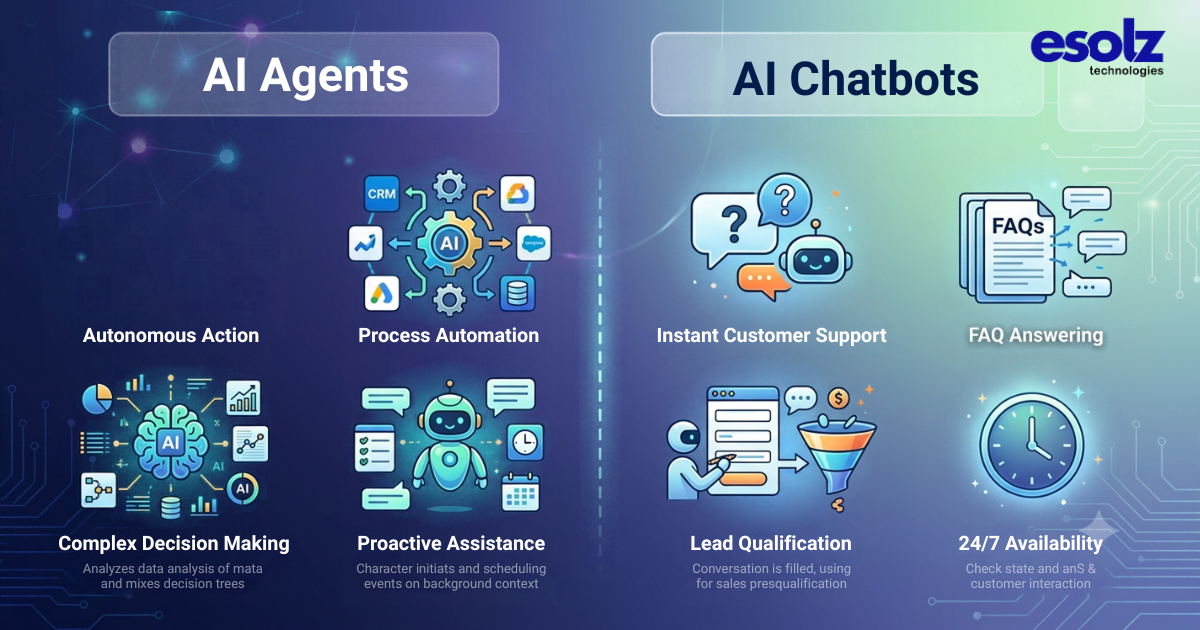
If you’ve been researching automation options for your business lately, you’ve almost certainly run into the debate around AI Agents vs AI Chatbots. The two terms get thrown around interchangeably in marketing pitches, but they are not the same technology. Picking the wrong one can cost you time, budget, and customer trust. At Esolz Technologies, we get asked about AI Agents vs AI Chatbots almost every week by clients who just want a straight answer: which one do I actually need? This blog breaks it down in plain language, with real business context, so you can make a decision that fits your goals instead of chasing a buzzword.
What Is an AI Chatbot, Really?
An AI chatbot is a conversational tool built to answer questions, guide users through simple flows, and handle repetitive queries. Most chatbots you interact with on e-commerce sites or banking apps fall into this category. They are trained on a defined set of intents and responses, often using natural language processing (NLP) to understand phrasing variations, but they don’t independently decide what to do next outside their scripted boundaries.
- Best for FAQs, order tracking, appointment booking, and basic lead capture
- Works within a fixed conversation flow or decision tree
- Cannot take real-world action beyond what’s explicitly programmed
- Cheaper and faster to deploy than a full AI agent system
What Is an AI Agent, and How Is It Different?
An AI agent goes several steps further. Instead of just replying to a message, an AI agent can reason through a multi-step task. They pull data from different systems, make decisions, and execute actions, like updating a CRM record, generating a quote, rescheduling a delivery, or triggering a workflow in another tool. This is the core distinction in the AI Agents vs AI Chatbots conversation: chatbots talk, agents act.
- Can plan and complete multi-step tasks with minimal human input
- Integrates with APIs, databases, and internal business tools
- Learns from context across a session, not just a single query
- Suited for operations, sales support, IT helpdesks, and back-office automation
AI Agents vs AI Chatbots: The Core Differences at a Glance
When businesses compare AI Agents vs AI Chatbots side by side, the differences usually come down to four things: autonomy, complexity of task, integration depth, and cost of ownership. A chatbot is reactive, meaning it waits for input and responds. An agent is proactive, meaning it can initiate steps, check for missing information, and pursue a goal across multiple tools or systems without waiting for a human at every stage.
This doesn’t mean one is universally ‘better.’ It means they solve different problems. A retail brand fielding thousands of repetitive ‘where is my order’ questions doesn’t need an autonomous agent architecture, since a well-built chatbot will do the job at a fraction of the cost. A logistics company trying to automate route replanning, vendor communication, and exception handling, on the other hand, needs the reasoning and action capabilities that only an AI agent can provide.
Why the AI Agents vs AI Chatbots Question Matters for Your ROI
Getting the AI Agents vs AI Chatbots decision wrong is one of the most common reasons automation projects underdeliver. Businesses that deploy a chatbot expecting agent-like autonomy end up frustrated with rigid, robotic interactions. Businesses that over-invest in a complex agent framework for a task a simple chatbot could handle end up burning budget. They spend on infrastructure, integrations, and maintenance they didn’t need.
The smarter approach is to map the decision to the actual complexity of the task, not the hype around the technology. Ask: does this workflow require judgment, multiple system integrations, and independent action? If yes, lean toward an agent. If the workflow is mostly about answering known questions quickly, a chatbot is the more cost-effective and reliable choice.
How Esolz Technologies Helps You Choose the Right Fit
At Esolz Technologies, we don’t push a one-size-fits-all solution. Every AI Agents vs AI Chatbots conversation we have with a client starts with understanding the business process first. We understand the volume of queries, the systems involved, the level of decision-making needed, and the budget. From there, we design and build whichever solution actually fits. A lightweight NLP-powered chatbot for customer support, a fully autonomous agent for internal operations, or a hybrid setup that uses both together.
- Custom chatbot development for customer-facing support and lead generation
- AI agent development integrated with your CRM, ERP, and internal tools
- Hybrid architectures where chatbots handle front-line queries and agents handle backend execution
- Ongoing optimisation based on real usage data, not assumptions
Final Thoughts
The AI Agents vs AI Chatbots decision isn’t about picking the trendier term for your pitch deck. It’s about matching technology to the actual problem you’re solving. Chatbots are excellent at fast, high-volume, well-defined conversations. Agents are built for complex, multi-step, cross-system work that used to require a human in the loop. Most growing businesses eventually need both, deployed strategically rather than interchangeably.
If you’re still unsure where your business falls in the AI Agents vs AI Chatbots spectrum, Esolz Technologies can help you map your workflows. We will recommend the right architecture, without overselling you on complexity you don’t need. Get in touch with our team to start the conversation.