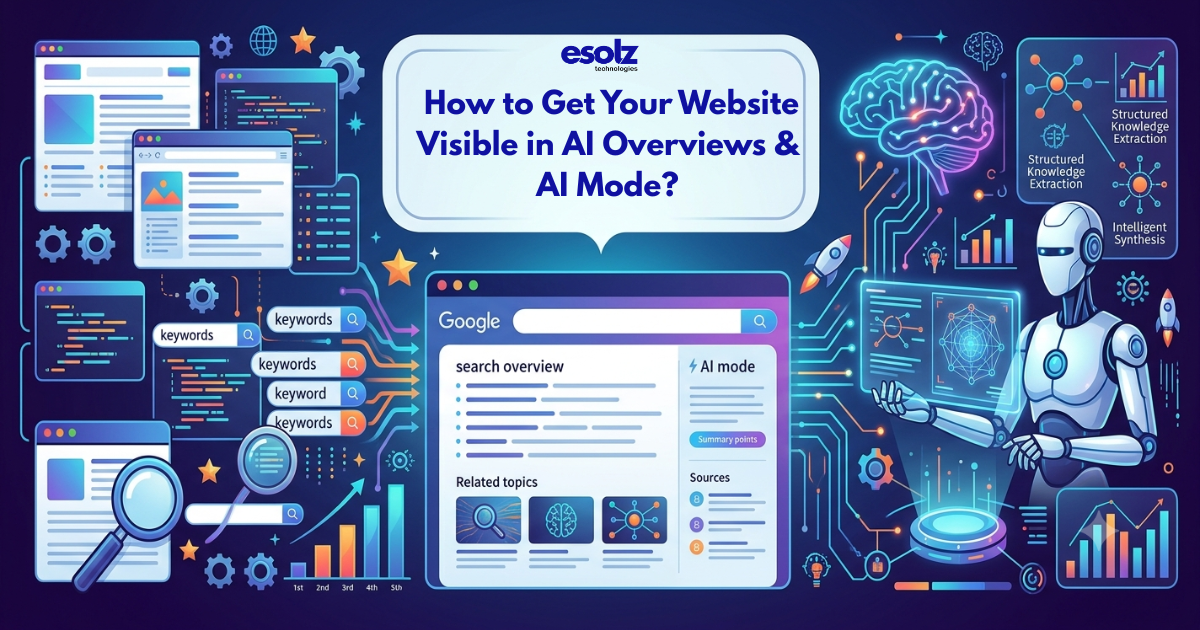
Half of all Google searches today may never produce a click. Not because people stopped searching – they’re searching more than ever. But because Google now answers the question itself, right there on the results page, before anyone reaches a website, GEO and AEO are now being prioritised.
That answer box is called an AI Overview, and it’s no longer a side experiment. It shows up on roughly half of all Google queries, and it sits above every ranking on the page, including the one you may have spent months earning. Add ChatGPT, Perplexity, Gemini and Copilot into the mix, and you’ve got a genuinely new game – one where getting “cited” by an AI matters as much as getting “ranked” by an algorithm.
At Esolz Technologies, this is exactly the kind of shift we track closely for our clients, because it changes what “good SEO” even means. This guide walks through what’s actually changed, what the numbers say, and – most importantly – what you can do about it this week. No jargon for the sake of jargon. Just what’s working right now, in 2026, backed by real data.
What has Changed in Search?
If you only remember one thing from this section, make it this: search results are no longer a list of ten blue links. They’re increasingly a written answer, generated on the fly, that may or may not send anyone to your website. Here’s the data behind that shift: GEO and AEO.
AI Overviews now appear on roughly 47–48% of tracked Google queries as of early-to-mid 2026, up from around 32% in Q1 2025 (BrightEdge, Presenc AI). Some individual industry trackers put commercial-query coverage even higher.
Healthcare queries trigger an AI Overview about 88% of the time; education around 83%; shopping and transactional searches are the least likely, at roughly 13–14% (SERPs.io / BrightEdge aggregation).
Question-style searches trigger AI Overviews about 60% of the time, and searches of ten words or more trigger one 53% of the time – versus just 8% for one- or two-word searches (Pew Research Centre).
Organic click-through rate on queries that show an AI Overview has fallen by roughly 34-64 %, depending on position and study (Seer Interactive). But brands that get cited inside the AI Overview see about 35% more organic clicks and 91% more paid clicks than brands left out entirely.
ChatGPT now has around 900 million weekly active users and roughly 50 million paying subscribers, sending an estimated 2.5 billion messages a day (OpenAI, via TechCrunch, Feb 2026).
Visitors who arrive from AI platforms convert noticeably better than average organic visitors – Seer Interactive measured conversion rates of 15.9% from ChatGPT and 10.5% from Perplexity, against roughly 1.76% for standard organic search.
Fewer than 10% of sources cited by ChatGPT, Gemini and Copilot also rank in Google’s top 10 for the same query (Growth Memo/industry tracking) – proof that ranking well and getting cited well are related, but not the same job.
Key Takeaway
The takeaway isn’t “SEO is dead.” It’s that SEO now has siblings: GEO and AEO. Making sure the AI reading your page can understand it, trust it, and quote it. That’s what people are starting to call GEO and AEO – and it’s become a core part of how we approach client strategy at Esolz Technologies.
GEO and AEO: What Do These Acronyms Actually Mean?
Generative Engine Optimisation (GEO)
GEO is the practice of structuring your content so AI tools like ChatGPT, Gemini, Perplexity and Google’s AI Overviews choose to cite it when they generate an answer. Think of it as SEO for a reader that never scrolls – it reads, summarises, and decides in one pass whether your page is worth quoting.
Answer Engine Optimisation (AEO)
AEO (Answer Engine Optimisation) is closely related and often used interchangeably with GEO. It focuses specifically on structuring content as direct, extractable answers – the kind that slot neatly into a featured snippet, a voice assistant reply, or the first line of an AI Overview.
In practice, you don’t need to treat GEO and AEO as two separate workstreams. If you write clear, well-structured, genuinely useful content with real expertise behind it, you’re doing both at once. It’s why our own process folds GEO and AEO into one connected content strategy rather than pitching them as separate services.
How AI Search Actually Picks What to Cite for GEO and AEO
This is the part most guides skip, and it’s the part that matters most. AI systems aren’t ranking pages the way Google’s classic algorithm does. They’re retrieving a handful of candidate pages, reading them, and deciding -sentence by sentence. A few patterns show up again and again in the research:
- Strong Google rankings still help a lot. Pages ranking #1 organically have roughly a 58% chance of also being cited in an AI Overview for that query; by position 10, that drops to about 14% (Growth Memo). AI Overviews lean heavily on Google’s existing index as a starting pool.
- Clear, direct answers near the top of the page get pulled first. A Princeton/KDD 2024 study found that adding statistics, citing sources, and including direct quotations lifted a page’s chances of being cited by up to 30- 41%. Keyword stuffing actively hurt visibility.
- Recency is a real signal. AI systems appear to favour content with a visible, genuine “last updated” date, especially on fast-moving topics.
- User-generated and community content punches above its weight. Reddit and YouTube are among the most-cited sources across AI Overviews and chat assistants – a reminder that forums, reviews and Q&A threads carry real trust signals now.
- Citations are unstable. Roughly 40–60% of cited sources change from month to month on both Google AI Mode and ChatGPT (Heeya / industry tracking). Getting cited once isn’t a finish line – it’s a position you have to keep earning.
- A named, credentialed author with a real bio matters more than it used to. AI systems are cautious about misinformation, so they lean toward sources they can verify – which means anonymous, byline-free content is at a real disadvantage.
A Practical GEO and AEO Checklist You Can Start Today
1. Answer the question in the first two sentences
Don’t bury the answer under three paragraphs of throat-clearing. For GEO and AEO, open the section with a direct, quotable answer, then explain, qualify and expand underneath it. AI summarizers lift the clearest sentence they can find – make that sentence yours.
2. Structure content the way a machine (and a skimming human) reads it
- Use real H2/H3 headings that match how people phrase questions (“How much does X cost” beats “Pricing Considerations”).
- Use genuine bullet points and numbered lists for anything sequential or comparative – don’t fake them with dashes in a paragraph.
- Keep paragraphs short. Three to five sentences is the sweet spot for extraction.
- Add a short FAQ section to every important page – it’s one of the highest-yield formats for both AI citation and Google’s “People Also Ask.”
3. Back claims with real numbers and named sources
Vague claims get skipped. Specific ones get quoted. “Our tool saves time” is forgettable; “our tool cut onboarding time from 40 minutes to 9” is exactly the kind of concrete, checkable line an AI model likes to lift into an answer.
4. Show who wrote it
Add a real author bio with credentials, a photo, and a link to a LinkedIn or professional profile. Include an “About the author” block and a visible last-updated date on every article. This is the E-E-A-T (Experience, Expertise, Authoritativeness, Trustworthiness) signal that both Google and AI models weigh heavily in 2026.
5. Use structured data (schema markup)
- FAQPage schema for FAQ sections.
- Article and Author schema with dates and credentials.
- Product, Review and HowTo schema where relevant.
Structured data doesn’t guarantee a citation, but it removes ambiguity – it tells the AI exactly what kind of content it’s looking at instead of leaving it to guess.
6. Get mentioned off-site, not just linked to
AI models draw heavily on Reddit threads, review sites, YouTube, forums and comparison articles when forming an opinion about a brand – often more than they draw on your own homepage. Being discussed accurately in those places (through genuine community engagement, PR, and reviews) feeds the same models that decide whether to recommend you.
7. Refresh your best content instead of only publishing new content
A well-structured page from 2023 that hasn’t been touched since is quietly losing citation share every month, because recency is a live ranking factor for AI retrieval. Set a quarterly cadence to update your top-performing pages with new data, new examples, and a fresh timestamp.
8. Make your site technically easy for AI crawlers to read
- Check robots.txt isn’t blocking GPTBot, Google-Extended, PerplexityBot or ClaudeBot if you want to be eligible for citation.
- Keep core content in server-rendered HTML, not locked behind heavy client-side JavaScript.
- Use clean, descriptive URLs and a logical internal linking structure – AI crawlers, like search crawlers, use links to understand what matters on your site.
Writing Content That Reads Like a Human (Because It Is One)
One more thing worth saying plainly: write the way you’d actually talk to a smart colleague. Vary your sentence length. Let a paragraph run short sometimes and longer other times. Use a specific example instead of a generic one. Admit a limitation or a trade-off instead of pretending everything is perfect. None of this is about tricking a detector – it’s about writing content with a genuine point of view, because that’s the content people (and AI models trained on people) actually trust and want to cite. It’s also simply how we write for every client at Esolz Technologies— overly uniform, keyword-padded copy reads as hollow to a human editor and, increasingly, gets deprioritised by AI systems trained to favour originality and depth over filler.
How to Measure Whether This Is Working: GEO and AEO
- Track “AI referral” traffic separately in GA4 – segment sessions from chatgpt.com, perplexity.ai, gemini.google.com and copilot.microsoft.com.
- Manually query your 15–25 most important topics in ChatGPT, Perplexity, Gemini and Google AI Mode each week and log whether – and where – you’re cited.
- Watch branded search volume and direct traffic, not just organic clicks. Being cited (even without a click) tends to lift brand recall and later branded searches.
- Keep an eye on which competitors are showing up in the same AI answers you’re aiming for – that tells you what content gap actually needs closing.
Frequently Asked Questions for GEO and AEO
These are the questions clients ask our team most often about AI search, GEO and AEO.
Is traditional SEO dead now that AI Overviews exist?
No. Strong Google rankings remain one of the biggest predictors of getting cited in an AI Overview – pages in position one are cited roughly four times more often than pages in position ten. GEO and AEO build on top of solid SEO; it doesn’t replace it.
What’s the actual difference between SEO, GEO and AEO?
SEO optimises for ranking and clicks on a traditional results page. AEO optimises for being pulled out as a direct, standalone answer (in featured snippets, voice search, or an AI’s first line). GEO is the broader practice of earning citations inside AI-generated responses across chat assistants and AI Overviews. In day-to-day work, the three overlap heavily and are usually pursued together.
How long does it take to see results from GEO?
Most teams report early movement in AI citation frequency within four to eight weeks of restructuring content. However, it depends heavily on how competitive the topic is and how strong the site’s existing authority signals are. Treat it as an ongoing practice. Do not treat it as a one-off project. Cited sources change month to month, so consistency matters more than a single big push for GEO and AEO.
Can I actually stop AI Overviews from using my content?
Partially. You can block specific AI crawlers (like Google-Extended) through robots.txt, which affects training and, for some tools, retrieval. But doing so also removes your chance of being cited and driving the referral traffic that comes with it. So most site owners choose to opt in rather than out.
Do I need to rewrite my entire website for AI search?
Not usually. Start with your highest-traffic and highest-intent pages – the ones already ranking reasonably well. Then, restructure those first with clearer headings, direct answers, and an FAQ block. That’s typically where the fastest wins show up.
Does adding an FAQ section really help?
Yes, and it’s one of the highest-return changes you can make. FAQ-formatted content maps directly onto how people phrase questions to AI assistants, and FAQPage schema makes the question-answer structure machine-readable. Thus, both Google and AI models rely on it when extracting a quick answer.
Will AI-detection tools flag my content if I use AI to help write it?
AI-detection tools are notoriously unreliable and regularly misflag human-written text, especially text that is well-structured or a little formal. The safer approach isn’t chasing a detector score. It’s writing with genuine specifics, real examples, a clear point of view, and your own editing pass. This naturally produces text that reads as authentic because it is.
Which platforms should I prioritise – ChatGPT, Perplexity, Gemini or Google AI Overviews?
Start with Google AI Overviews and Gemini, since they draw heavily on your existing Google rankings and reach the largest audience. Perplexity rewards high-authority backlinks and data-rich content, and tends to be the most transparent about its sources. ChatGPT rewards dense, well-organised information with strong headings. Check your own analytics referral data before investing heavily in any one platform.
Does structured data (schema markup) actually influence AI citations?
It doesn’t guarantee a citation. However, it removes guesswork for the AI system about what your content is and how it’s organised. FAQPage, Article, Author and Review schema all make extraction easier and more accurate. This correlates with better citation rates in most industry tracking so far.
Why do Reddit and YouTube show up so often in AI Overviews?
AI systems appear to weight community and user-generated content heavily because it reads as unfiltered, first-hand experience. It is exactly the kind of signal that’s hard to fake. It’s a strong argument for showing up authentically in forums, reviews and video content, not just polishing your own website.
How do I know if GEO and AEO are actually sending me traffic?
Check your GA4 referral sources for traffic from chatgpt.com, perplexity.ai, gemini.google.com and copilot.microsoft.com. Even without much click volume, also watch your branded search and direct traffic. A citation without a click still tends to build brand awareness that shows up later.
What’s the single highest-impact change I can make this week for GEO and AEO?
Pick your five most important pages. Rewrite the opening of each key section so it answers the question directly in the first two sentences. Then add a well-structured FAQ block underneath with a named author and a visible update date. It’s a small change with an outsized effect on both AI citation and classic SEO.
Is it worth hiring a specialist GEO and AEO agency, or can I do this in-house?
Most of the highest-impact changes – clearer answers, better structure, real author bios. FAQ schema are things any content team can implement without new tools. Specialist help earns its cost mainly for ongoing monitoring across multiple AI platforms and for larger sites where manual auditing doesn’t scale. A partner like Esolz Technologies typically comes in.
AI search isn’t a passing trend to wait out – it’s already the default entry point for close to half of all searches, and that share is climbing. The sites that adapt GEO and AEO now, by writing clearly, backing claims with real numbers, and structuring content the way both people and machines actually read, are the ones that will keep showing up in the answer.